24/7 incident line
1800 370 270
For organisations under active attack.

Breach remediation
If you have suffered or suspect a security breach anywhere in Australia, remediation starts with establishing what happened and containing any continuing access.
24/7 incident line
For organisations under active attack.
The responders
Our testers hold postgraduate cyber qualifications, ISC2 certification and ACS and AISA membership.
Insurance
Professional indemnity, public liability, cyber and workers' compensation insurance, all current.
Overview
Black Shard provides breach remediation. We investigate the affected systems, determine the likely entry point and scope, and work with your team on containment. Once the incident is understood, we remediate the underlying application, infrastructure or configuration issues and verify the affected surface afterwards.
Where the incident carries obligations under the Notifiable Data Breaches scheme, we prepare the technical facts management and legal advisers need. We do not provide legal advice.
Breach remediation contains the incident, fixes the weakness behind it and verifies the fix, reporting to you in writing at each stage.
What the engagement covers
Engagement
A fixed-scope engagement: investigation and containment first, then remediation and verification of the affected surface.
Fixed-scope engagementA test or review with a set target, timeframe and deliverable.
Scope
Incident containment and triage
Establish what happened, what was reached, and contain any continuing access.
What you get

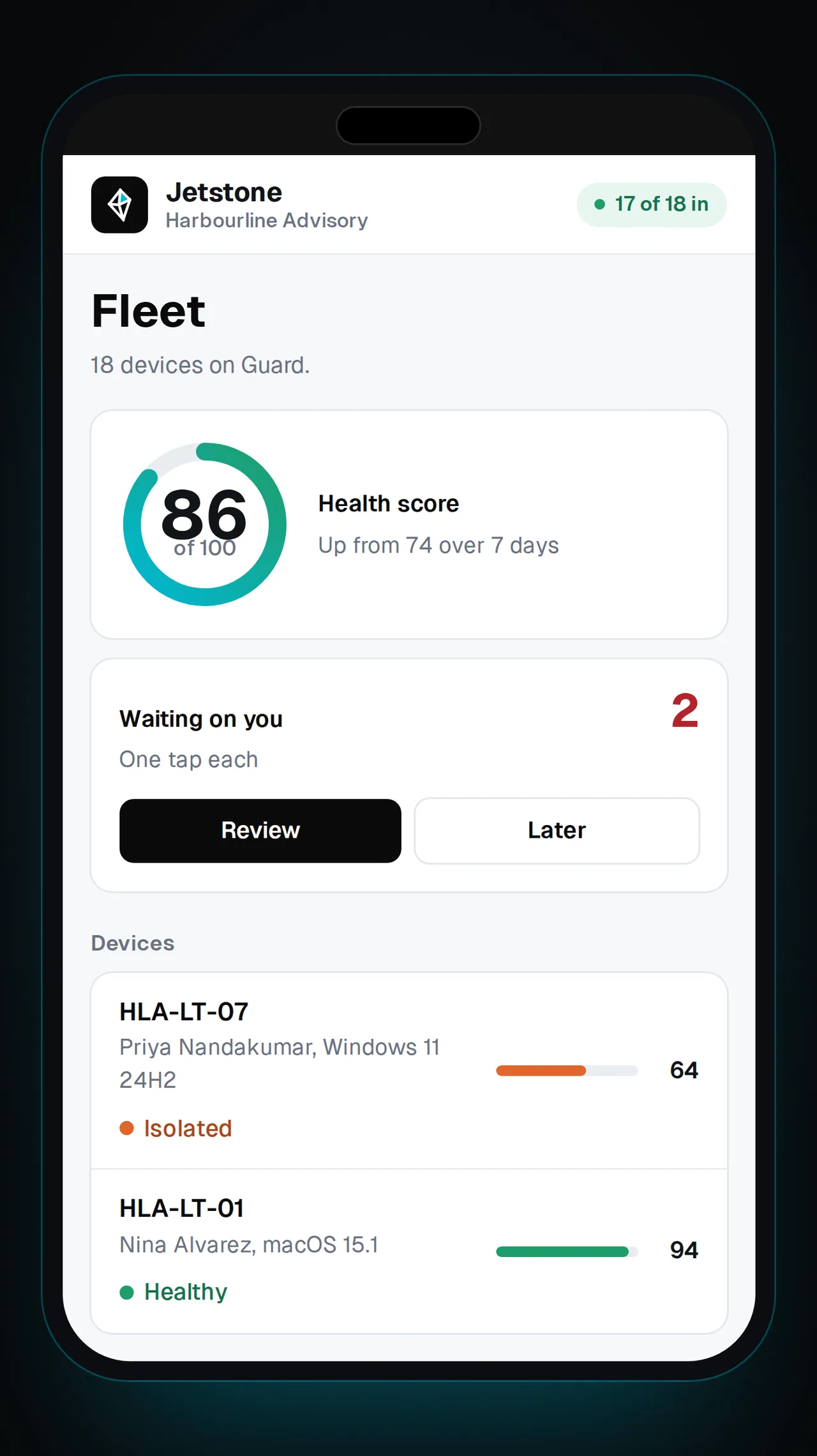
Launching 2027
Designed for Australian businesses with 1 to 200 devices.
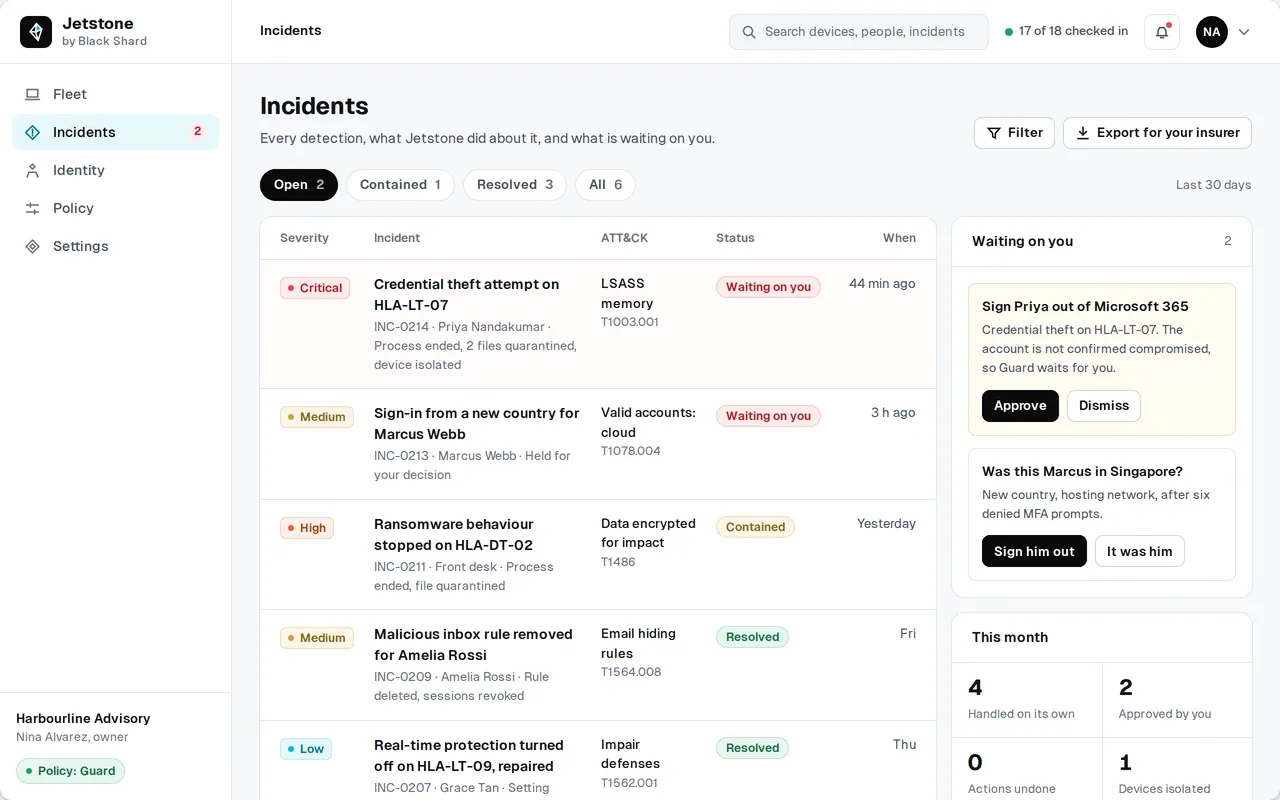
On a high-confidence detection, Jetstone is designed to act on its own against threats on a published list: end the process, quarantine the file, isolate the device, or sign the user out of Microsoft 365 or Google Workspace.
Identity watch will flag impossible travel, MFA fatigue, malicious inbox rules and risky OAuth consents.
Every automatic action will be undoable in one tap.
The work that follows a security incident: triage to establish the entry point, scope and data touched, containment of continuing access, root-cause analysis, and the engineered fix to the weakness behind it. It ends with a re-test of the affected surface. Where personal information may be involved, we prepare the factual report for the Notifiable Data Breaches assessment.
Engineers who build and run production software in regulated industries, and who also run the firm's offensive testing practice. The person who traces your incident to root cause ships and attacks systems like yours, so the fix is engineered and shipped.
Call the 24/7 incident line on 1800 370 270. Engagement covers containment, root-cause analysis, remediation engineering and a re-test.
Yes. A suspected incident is a legitimate brief, and triage is the first phase of the engagement either way: establishing what happened, what was reached, and whether the compromise is still live. If the triage shows no incident, you get that finding in writing, along with whatever weaknesses the investigation surfaced.
Under the practices we apply to our own estate. Access is least-privilege, and containment actions are agreed with you before they are taken. Engagement material is encrypted in transit and at rest, few third parties touch it, and client data is hosted in Australian regions.
Yes, with a clear boundary. We establish the facts the Notifiable Data Breaches assessment rests on: what was accessed, who is affected and what remediation has been done, and write them up for the assessment and any notification. We do not give legal advice; your legal advisers make the legal judgement from that report.
A penetration test finds the holes before an attacker does. Breach remediation follows an incident, confirmed or suspected: containment, root cause and the engineering fix. It ends the way our offensive work does, with a re-test of the fixed surface.
Yes. Containment, root-cause analysis and remediation run against your systems wherever they are hosted, and scoping, containment coordination and the debrief run by phone, video and secure access.
Yes, with standing terms agreed before an incident: a named response lead, a response-time target set at a level we meet today, an annual readiness review and hourly rates agreed in advance. The incident response retainer sits beside the incident line.
By scope. Breach remediation runs as a fixed-scope engagement: triage and containment first, then remediation scoped against what triage found. The size of the affected surface, the state of the systems and any Notifiable Data Breaches support drive it. We do not publish prices, because a number without a scope misleads.
Go deeper

Every finding reproduced by hand, ranked, and re-tested after the fix.

A named security lead for the board, and tenant reviews setting by setting.
Essential Eight, SMB1001, ISO 27001, Privacy Act and AML/CTF, carried through to the evidence an auditor reads.
From the newsroom

Updated Guides

Updated Guides