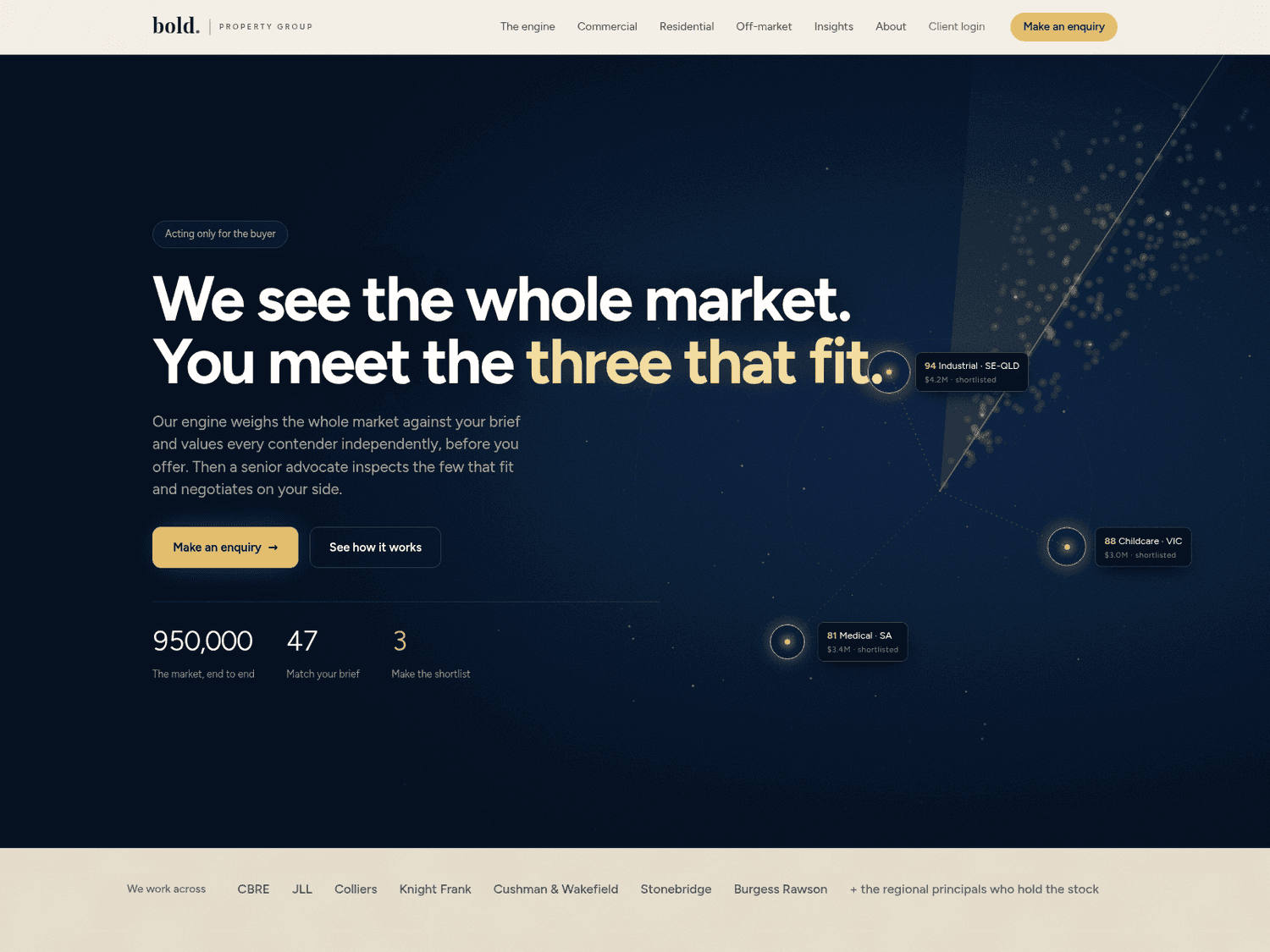
A new buyer’s agency, built from the brand to the deal-flow systems.
Brand, website, deal-sourcing infrastructure and client portal for a buyer’s advocacy business.
- Client
- Bold Property Group
- Sector
- Buyer’s advocacy
- Stack
- React, FastAPI, n8n
- Staff sign-in
- Microsoft Entra ID
Bold is buyer-side only, acting for the buyer through the whole transaction: acquisition strategy, due diligence, settlement and post-close asset operation. The agency needed a stack it could iterate on weekly: brand, marketing site, deal-pipeline tooling, and a private portal for clients to track an active acquisition.
What we designed and run
We designed the identity, shipped the marketing site, built the agent-network data layer for sourcing off-market opportunities, and stood up the client portal. The agency runs on that stack today, and Black Shard operates and hardens it on Bold’s behalf.
What we built.
- Brand identity and editorial site
- Off-market deal-sourcing agent network and scraping rig
- Client portal for active acquisitions
- Portal CRM and client-report engine: acquisition review reports with comparables and due-diligence priorities, as branded PDFs
- A fail-closed AML/CTF identity gate: no signed engagement and no address reveal until verification of identity is recorded
How it is secured.
Compliance is enforced in code, fail-closed: the portal will not let an engagement letter be signed or a property address be revealed until verification of identity is recorded.
Inside the build.
The deal room
Bold's staff portal runs each acquisition as a deal: a pipeline board, a deal room for each purchase, due-diligence intake and review, the due-diligence report, offers and settlement, with a settlements view that follows each purchase to completion. A deal moves through six stages, prospect, searching, shortlisted, offer, contract and settled, and the pipeline board and the deal room read the same list. Conveyancers are kept as records of their own, each with the active deals they are on, and are assigned to deals from a picker, and each offer is linked to the deal it belongs to.
The engagement letter is reviewed and sent from one screen: the buyer's agent sees the letter itself, can tailor the fee terms and the cover note, and sends it for signature. Every engagement letter carries a second signer: after the client signs, the agency countersigns in the portal.
Reports run as background jobs and arrive as branded PDFs. The portal polls each job and says when its report is ready. Every generated document is checked against a written document contract, which a script enforces on the context keys each generator needs.
Sourcing and market intelligence
The intelligence side of the portal holds the agent network and each agency's record, comparable sales with a record for each sale, a page for each suburb, market data, commercial intelligence, a research library and a sourcing feed of off-market opportunities. The feed runs in two modes: the broad search pool, or only live listings matched to an active client brief. The agent network is built from sourced listings, with each agent's source tags collapsed so one agency reads as one record. Selling agents can submit a property straight into the platform through a submission endpoint.
Reverse briefs work from the other end. An operator picks a client, previews the agents whose stock matches the brief, and commits drafts, which land in the email queue for review. Nothing sends without passing the review gate.
Agent outreach runs in sweeps. An operator previews the eligible agents as a count and a sample, drafts the whole sweep into the outreach mailbox, and then tracks what the agents upload in reply through a tokenised hub page that sits outside the portal shell.
The client and referrer portals
Clients follow their purchase in a portal of their own. Property addresses stay masked until the engagement letter is signed in the portal and verification of identity is recorded, and paying the engagement fee unlocks instructing the agency on a property. The fee shows with its GST separately, and the portal records when it was paid. The due-diligence report is available in the client's view. Each outstanding step, the letter, the payment and verification of identity, shows as a task in the client's checklist until it is done.
Referral partners have a separate portal for the introductions they make, tracked on the staff side in a referrals view.
Content and operations
Staff start the day in the command centre, with the day's priorities and a health board that places each client by the state of their search. E-signature envelopes are tracked in one staff view.
The same portal runs Bold's content and operations: a content studio, social content with its own queue, case studies, PR outreach, SMS and email queues, a task queue, automation settings, cron and system health views, and the team roster.
Behind it, a FastAPI service handles enquiries and their export, newsletter sign-ups, lead-magnet downloads and SMS deal notifications.
The command centre on the desktop
Staff use the portal inside the Bold Command Centre, a hardened Windows desktop shell. It runs with no preload script and no Node.js in the renderer, signs staff in through Microsoft Entra ID inside the window, and renders only the portal, its client and referrer hosts, and the Microsoft sign-in pages. Every access rule stays enforced on the server.
How it is built
Bold runs as a set of services on its own production server: the React staff portal, the separate client and referrer portals, the FastAPI backend, n8n workflows for automation, and Caddy in front, under Docker Compose. A change lands by pull request and the server pulls the reviewed branch. Staff sign in to the portal with Microsoft Entra ID, and a pre-commit gate runs ruff and ESLint on every commit.
The public site carries the brand, the editorial content, the 46-point due-diligence framework and an off-market page.
Services involved.
Start an engagement.
Tell us what you need built, reviewed or secured.