
Report
Known exploited vulnerabilities, January to March 2026: what the CISA catalogue says about the patching clock
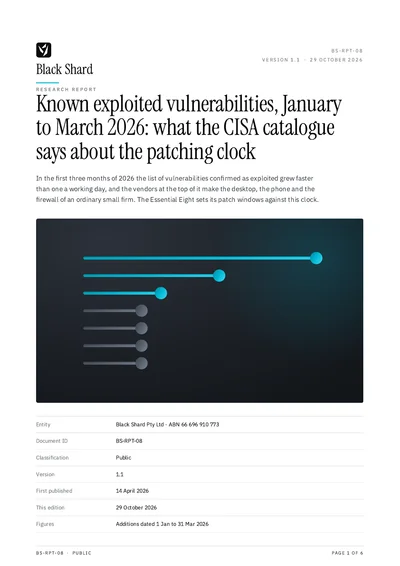
In the first three months of 2026 the list of vulnerabilities confirmed as exploited grew faster than one a working day, and the vendors at the top of it make the desktop, the phone and the firewall of an ordinary small firm. The Essential Eight sets its patch windows against this clock.
- Additions dated 1 Jan to 31 Mar 2026
- First published 14 Apr 2026, this edition 29 Oct 2026
- PDF, 6 pages, 235 KB
- BS-RPT-08, version 1.1

Executive summary
CISA added 71 vulnerabilities to its Known Exploited Vulnerabilities catalogue between 1 January and 31 March 2026, across 38 vendors. The additions ran 17 in January, 28 in February and 26 in March.
Microsoft accounted for 12 of the 71 additions, Apple for 7 and Cisco for 4; Synacor, Google, SolarWinds and SmarterTools had 3 each. The seven vendors with three or more additions account for 35 of the 71; the other 31 vendors share the remaining 36, most of them with a single entry.
The catalogue is a short list by design. An entry is a flaw that an attacker has already used against a real system, with a fix available, and nothing else qualifies. Read that way, the quarter is a count of the doors that opened in software a small firm runs: Windows and Microsoft 365 on the desks, iPhones in pockets, a Cisco or equivalent appliance on the office boundary, and a mail server or helpdesk tool somewhere that nobody has logged into for a year.
From Maturity Level 1, the Essential Eight requires patches for vulnerabilities in online services within 48 hours of release when the vendor rates the flaw critical or a working exploit exists, and within two weeks otherwise. An entry in the catalogue is the definition of a working exploit, so each addition that touches an online service starts the two-day clock on the day it lands.
A small firm meets that clock by preparation. Every one of the quarter’s additions was matched to a firm’s own software, or missed, by whether the firm had an inventory to match it against, a person allowed to patch outside the monthly cycle, and a plan for the service that could not be patched in time.
- Keep an inventory of every product you run or rent, with its vendor and version, including the devices on the office boundary and the services a provider patches for you.
- Match the catalogue feed against that inventory every week and give each match a due date from the Essential Eight windows.
- Decide now who may patch out of cycle, how a change is reversed, and what happens to an exposed service when the fix cannot land in two days.
Report
The figures
Additions by month, January to March 2026
Additions by vendor, January to March 2026
What to do
- Write down every product you run or rent, with its vendor and version: the desktops and their applications, the phones, the firewall and VPN gateway, the mail and file servers, the tools a contractor installed, and the hosted services whose patching belongs to someone else.
- Subscribe to the catalogue feed and match it against that inventory every week. A match on an internet-facing system opens a ticket due in two days; any other match takes the window the maturity model sets for that class of software.
- Name the person who may patch outside the cycle and the person who approves it, and rehearse one out-of-cycle patch so the path is known before a Friday afternoon entry lands.
- Write the rollback for each exposed service and the compensating step when a fix cannot land in time: restrict it at the boundary, disable the component, or take it offline.
- Ask each hosted provider in writing how it handles a catalogue entry for the software it runs for you, and how it tells you.
- Retire what the vendor no longer supports. An unsupported product on the catalogue has no patch coming, and the maturity model removes it at every level.
- Read the windows back from the systems: the date of the last applied patch on each device and service against the vendor’s release date, every month.
We run patching to the Essential Eight windows for clients, with the catalogue matched against their inventory each week and every match worked to its due date, and our attack surface monitoring watches what a client exposes to the internet so the match is made against what an attacker can reach. An Essential Eight assessment reads the patch windows back from the live systems and sets the uplift in order. Scope and price are at blackshard.com.au/essential-eight-assessment.
Method
The Cybersecurity and Infrastructure Security Agency in the United States keeps the Known Exploited Vulnerabilities catalogue under a binding directive it issued to federal agencies in November 2021. A vulnerability goes on the list when it has a CVE identifier, there is reliable evidence that it has been exploited against real systems, and the vendor has published a fix or a mitigation. The catalogue carries no severity score. Every entry is past the question of whether an attacker could use it.
The feed records the day CISA added each entry, and that date never changes, so the count of entries added between 1 January and 31 March 2026 is the same in every later version of the catalogue. We counted those entries, grouped by calendar month and by the vendor name the catalogue gives each entry. The vendor count is the number of distinct vendor names; a vendor with several affected products counts once. The ransomware figure is the catalogue’s own flag for entries CISA links to a known ransomware campaign, as it stands in the catalogue version of 28 October 2026; CISA sets the flag when evidence arrives, so the count rises over time.
The date of addition is the day CISA listed the entry. The flaw itself may have been public, and exploited, for weeks or years before that, and the catalogue holds only what CISA has confirmed, so every figure here is a floor. No CVE is named. The point is the volume and where it falls.
The same count is worth running in your own estate every week, against your own inventory. Download the feed, match the vendor and product fields to the software, devices and hosted services you hold, and open a ticket for every match. A match on an online service, an internet-facing server or a network device starts the two-day clock at every maturity level; a match on anything else takes the window the maturity model sets for that class of software, and at Level 3 the critical and exploited flaws in the common desktop applications move to two days as well. The feed carries CISA’s own due date for US agencies; the Essential Eight clock is the one an Australian firm is assessed against.
The match is only as good as the inventory. A feed matched against a spreadsheet of laptops finds Microsoft and Apple and nothing else, because the firewall, the VPN gateway, the mail server and the tools a contractor installed were never written down. Those are the entries in the tail of the vendor table, and they are the ones that go unpatched.
BS-RPT-08, published 14 Apr 2026, revised 29 Oct 2026
The full report, as a PDF
PDF, 6 pages, 235 KB. Additions dated 1 Jan to 31 Mar 2026.
More reports

Report
Security events by hour: what our monitoring sees
Measured 26 Oct 2026, 00:45 AEST · PDF, 6 pages, 213 KB

