Report
Security questionnaires and tenders: what buyers ask, and how to answer
Buyers ask about the same controls in different words. A supplier that keeps the record behind each answer, and states its gaps with a date, answers faster and is believed.
- Tools read 26 Oct 2026
- PDF, 8 pages, 279 KB
- BS-RPT-05, version 1.0

Executive summary
Our security questionnaire translator sorts each question into one of 56 control families. It flags 8 of the 56 as asking for an artefact that most small and mid-sized suppliers do not hold.
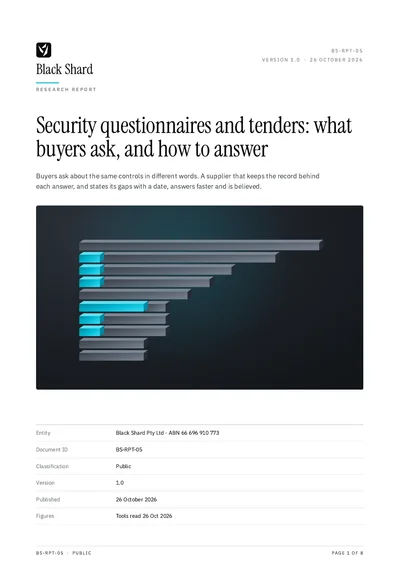
We group the 56 families into 10 themes, the way a tender response is usually organised. Infrastructure, devices and email: 11 control families, none of them scarce. Assurance and testing: 4 control families, 3 of them scarce.
Our cyber insurance readiness check asks 22 questions in 9 groups, grouped the way proposal and renewal forms group theirs.
Most questions are answered from records a well-run firm already keeps: a policy export, a backup restore record, a list of administrators, a certificate of currency. The questions that hurt are the few that ask for an artefact the supplier does not hold, and the answers that hurt most are the ones that imply it does.
- Keep one evidence pack with the record behind every common answer, and update it when a control changes.
- Answer each question with what is in place, the exceptions, and the date they close.
- For a scarce artefact, say plainly that you do not hold it, and offer the evidence you do.
Report
The figures
What security questionnaires ask about
The answer pattern
What a cyber insurance proposal form asks
What to do
- Build an evidence pack: the security policy, the multi-factor enforcement export, the backup restore record, the administrator list, the incident response plan, the insurance certificates and any certificate or assessment you hold.
- Write one master answer for each control family, from the pack, and reuse it in every questionnaire.
- State each gap with the date it closes, and keep the dates.
- For a scarce artefact, answer with the control you run and its evidence, and never imply the artefact.
- Answer the insurance proposal form from the same pack, because the insurer will read it again after a claim.
- Review the pack when a control changes, and at least once a year.
- Run a questionnaire you have received through our translator before you answer it, to see which families it falls into and which ask for something you do not hold.
Our free tools run in the browser with nothing sent to us: the security questionnaire translator, the cyber insurance readiness check, the Essential Eight check and the penetration test scope builder.
Method
Our security questionnaire translator reads a pasted questionnaire line by line and sorts each question into a control family from a fixed dictionary, most specific first. For each family it states what the question is reaching for, the record that answers it and a truthful partial answer, and it flags the families that ask for an artefact most small suppliers do not hold. It runs in the browser: nothing entered into it is sent to us.
We counted the families and the flags in the tool’s source on 26 October 2026. We group the 56 families into 10 themes, the way a tender response is usually organised. The themes are ours; the families and the flags are the tool’s.
Our cyber insurance readiness check asks 22 questions in 9 groups, grouped the way proposal and renewal forms group theirs. We counted its groups and questions from its source on the same day.
No customer data is in any figure. The counts describe the tools, never what anyone typed into them.
BS-RPT-05, published 26 Oct 2026
The full report, as a PDF
PDF, 8 pages, 279 KB. Tools read 26 Oct 2026.
More reports

Report
Security events by hour: what our monitoring sees
Measured 26 Oct 2026, 00:45 AEST · PDF, 6 pages, 305 KB

Report
Notifiable data breaches, read for small and mid-sized firms
OAIC figures of 6 Jul 2026, read 26 Oct 2026 · PDF, 7 pages, 230 KB