

SENTINEL
Race-weekend decision software with thirteen proprietary engines
Proprietary decision engines for the race weekend. Your people make every call.
Pit, safety car, qualifying and rules calls priced in seconds, each on a decision Card with an owner and a deadline.SENTINEL prices each pit, safety car, qualifying and rules call in seconds and puts it in front of its owner as a decision Card with a deadline. Its race simulation stages nine answers on every leader lap, so the call is priced before the trigger fires.
Built by Black Shard Labs. Running today on live and replayed timing data.
Baku street circuit, drawn by SENTINEL’s renderer.
The build
Web and native apps
A web app and native apps for Windows, iOS and Android.
Running today
SENTINEL runs live in a Black Shard showcase.
Public timing data
SENTINEL runs on public timing data, replayed and live.
Thirteen engines
Written by Black Shard, each with a written model card. More than 500 test files cover the product.
The race weekend
A car stops on track. The pit entry is twelve seconds away.
A race turns on a few calls, and each one has a deadline measured in seconds. The strategist has to choose between boxing and staying out, between one car and both, and between covering a rival and holding track position. The answer comes from whatever is on the screen when the moment arrives.
Timing feeds stall, GPS drops and a sector time arrives late. A number worked out from stale data looks the same on a screen as a number worked out from live data. A pit wall can act on a call when it knows the condition of the data, who owns the decision and how long they have.
The decision engines
Thirteen proprietary engines read the race, lap by lap.
Black Shard wrote each engine. Each answers one race question, and each has a written model card and its own tests.
Simulation and warning
Two engines watch the whole race.
TWIN race simulation
A Monte Carlo simulation that runs the race to the flag on every leader lap. It stages the outcome under green running, a safety car and a virtual safety car, for each option: stay out, box one car or box both.
SC-Nowcast
Scores the chance of a safety car or virtual safety car every second from the live feed: a car slow or stopped, how far it sits from the racing line, and the yellow flags around it. When the score climbs, the warning Card can be on the wall before race control makes the call.
Strategy
Seven engines work the stop from your car’s side and the rival’s.
Pit window
On every green lap, for each car: the laps priced close to the best stop lap, and what stopping now is worth in seconds.
Undercut and overcut
For each rival within reach: the chance it stops in the next three laps, and the gap each response leaves.
Clean-air rejoin
For a stop in the next three laps: where each choice puts the car back on track, behind whom, and what that costs over the laps that follow.
Tyre cliff
For each car, the laps left before pace falls away from the stint’s own reference. The forecast was learned from six past seasons of public timing.
Rain crossover
When the track is wetting or drying: whether the other tyre is already quicker, and what boxing now costs against waiting one lap or two.
Rival stop read
For each rival around your cars: the lap window of its next stop, the likely compound and the reasons. Six strategy reads sum up the race at that moment.
What-if on demand
Type a what-if in plain English. SENTINEL runs it as a simulation against the race on screen and shows the changed race beside the unchanged one.
Qualifying, rules and the driver
Four engines cover the rest of the weekend.
Qualifying release
When to send each car for a clear push lap, and whether to push or run another preparation lap.
Track-limit strike ledger
Strikes counted for each driver from the official race-control messages.
Driver coaching
Each lap set against a reference lap, corner by corner, to show where the time went.
- Debrief
Energy read
Energy deployment goes into the debrief, lap by lap.
How a call is priced
TWIN runs the rest of the race on every leader lap.
TWIN is a Monte Carlo simulation. On every leader lap it runs the race to the flag many times for each option and ranks the options by expected points, with a finishing range for each car. It does this for green running, a safety car and a virtual safety car, so all three answers exist before any of the three happens.
A strategist who starts the sums when the safety car board comes out spends part of the deadline on them. TWIN finished them on the previous leader lap.
One call, from the wall
Lap 31. A car stops at turn four.
Staged
The answer is already staged.
TWIN finished its run on the last leader lap. It holds the race to the flag under a safety car for three options: stay out, box one car and box both.
Warning
The warning Card is raised.
SC-Nowcast scores the live feed every second. A car has stopped near the racing line, the score climbs, and a Card goes to the strategist.
Card
The Card names its owner and its deadline.
The options are listed in the order TWIN ranked them, with the seconds at stake on the Card. The data behind the Card reads live.
Call
The strategist makes the call.
The strategist chooses to box both cars. The verdict goes on the audit chain beside the Card.
Scored
The call is scored at the flag.
The scoreboard logged the call with its time and a digest of its inputs. When the race is over it scores the call against what happened.
The decision Card
One Card for each call.
A Card carries one decision. It lists the options in ranked order and states the seconds at stake.
An owner.
Each Card names the role that owns the call.
A deadline.
Each Card shows how long the owner has before the call lapses.
Seconds at stake.
Each Card states what the call is worth in seconds of race time.
Data trust.
The Card states the condition of the data behind it: live, STALE or NO DATA.
The verdict.
The owner’s verdict goes on the audit chain with the Card.
Confidence and data trust
Every Card states the condition of its data.
Live, STALE or NO DATA
A Card reads live, STALE or NO DATA. A STALE or NO DATA Card reads NO RECOMMENDATION.
Backtested lap by lap
At lap 31 TWIN sees laps 1 to 31. TWIN and the strategy, qualifying and coaching engines are backtested on completed 2026 races, and the results are kept with the code. Every change to TWIN passes a backtest against recorded reference runs before it is merged.
Every call scored
Every forward-looking call is logged with its time and a digest of its inputs. When the outcome is known, the scoreboard scores the call against it on the Accuracy screen.
- On the roadmap
Your team’s data
A connector for a team’s own session data, with the engines calibrated on it.
The language layer
Ask the race in plain English. Every number is checked.
The engines do the strategy maths. The language model puts an answer into words, and a validator checks every number in that answer against the facts sheet before it is shown.
The engines, the facts sheet and the validator are proprietary SENTINEL technology.
Answer validator
Every number in an answer is traced to the facts sheet before it is shown.
Assistant and command bar
Ask a question or type a plain-English line. The command bar answers from an engine or a tool.
Pit wall crew
Four roles each give a one-line position on the moment. A chair lists the options in the order the engines ranked them and names the dissent. The call stays with the Card’s owner.
Team radio intel
Broadcast team radio is transcribed, tagged and passed to the strategist within seconds during a live session.
Rules and stewards copilot
Every regulation answer cites its article or decision number. It drafts protest, review and appeal outlines, marked DRAFT, for your people to review.
People decide
The Card’s owner makes the call.
SENTINEL lists the options and ranks them, and a person chooses.
A strategist under pressure needs the dissent as well as the favourite, so the crew’s chair names it each time the crew is asked. When the call is made, the verdict goes on the audit chain beside the Card that prompted it.
Options in ranked order
The Card lists the options in the order the engines ranked them. The owner’s verdict is recorded beside that ranking.
Audit chain and debrief
Calls, Cards and operator verdicts are chained in order. The debrief is built from that chain when the race ends.
After the flag
Where the season’s time went.
SENTINEL reviews the calls after the flag, for one decision, for one weekend and for a whole season.
Time Ledger
For each team, the seconds that were available over the completed races in three decision areas: stops under a safety car, time penalties and clean-air rejoins.
Championship simulator
A Monte Carlo simulation of the remaining rounds that turns seconds into points.
Season review
Every decision point of a team’s season, reviewed one by one.
The track
23 circuits, drawn live in Unreal Engine 5.
SENTINEL’s render pipeline builds each circuit from a track specification and drives the live view in Unreal Engine 5, with its kerbs, barriers and walls. The renderer runs above 60 frames a second on a high-end graphics card.
Read the release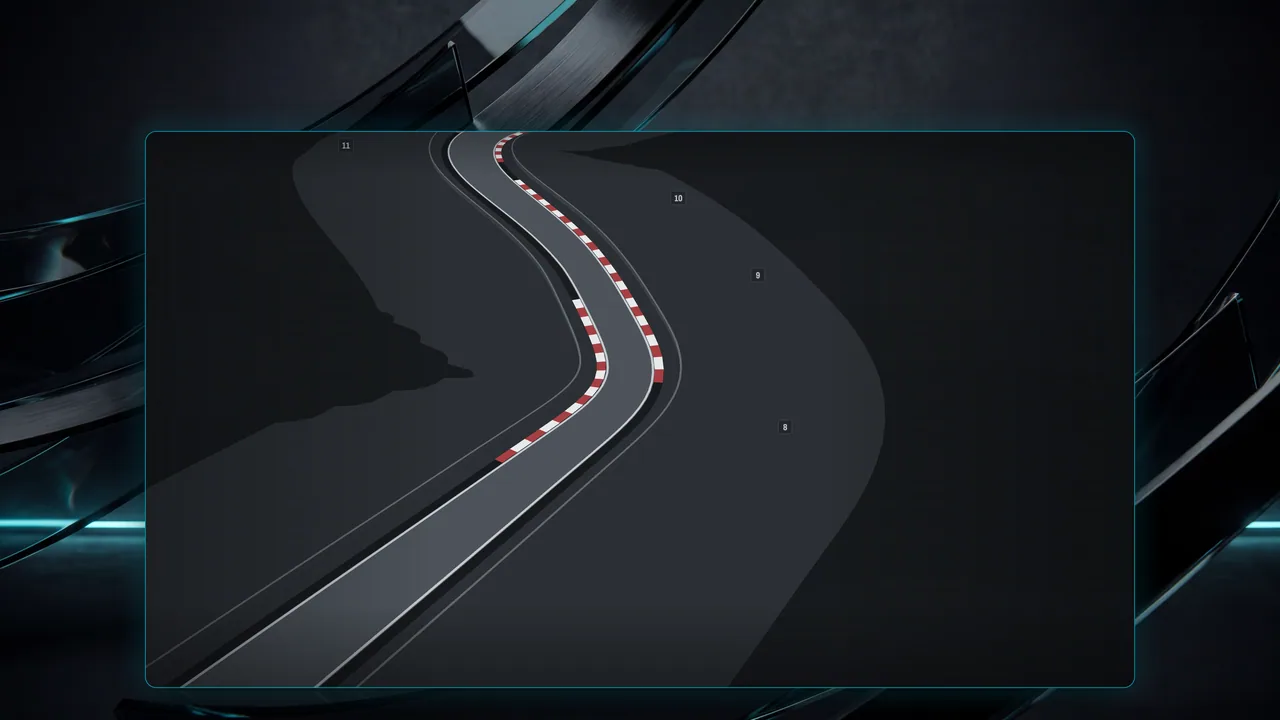
The Unreal Engine 5 view runs in the Windows desktop app, and the browser draws the track in WebGL.
Platforms
Web, Windows, iOS and Android.
Ten screens
Weekend, Pit Wall, Strategy, Driver, Season, Rules, Radio, Record, Accuracy and Crew.
Native apps
Windows, iOS and Android. The Windows app carries the Unreal Engine 5 track view.
- On the roadmap
A second series
Cards, strategy, radio, rules and coaching on a second series.
Questions
Questions about SENTINEL.
What is SENTINEL?
Race-weekend decision software for elite motorsport, built by Black Shard Labs. It prices pit, safety car, qualifying and rules calls in seconds and shows each one as a decision Card with an owner and a deadline.
Where can I see SENTINEL?
Black Shard hosts a live showcase running on live and replayed timing data. Ask us for a walk-through.
Who makes the call?
The Card’s owner. SENTINEL lists the options in ranked order, the owner chooses, and the verdict goes on the audit chain.
How does SENTINEL show the condition of its data?
Every Card states whether its data is live, STALE or NO DATA. A STALE or NO DATA Card reads NO RECOMMENDATION.
Who built the decision engines?
Black Shard. The thirteen engines, the Card system, the facts sheet and the answer validator are proprietary SENTINEL technology. The engines do all of the strategy maths, and each has a written model card and its own tests.
How are calls scored?
Every forward-looking call is logged with its time and a digest of its inputs, then scored against what happened once the outcome is known. The scores sit on the Accuracy screen.
What data does it use?
Public timing data, replayed and live. A connector for a team’s own data is on the roadmap.
Where does SENTINEL run?
In a browser, and as native apps for Windows, iOS and Android. The Unreal Engine 5 track view runs in the Windows app.
Which circuits and series does it cover?
The renderer draws 23 circuits. The Cards and strategy engines run on live series timing, and a second series is on the roadmap.
SENTINEL
Ask Labs about SENTINEL.
Tell us about your team and the calls you want priced.
Ask about SENTINEL